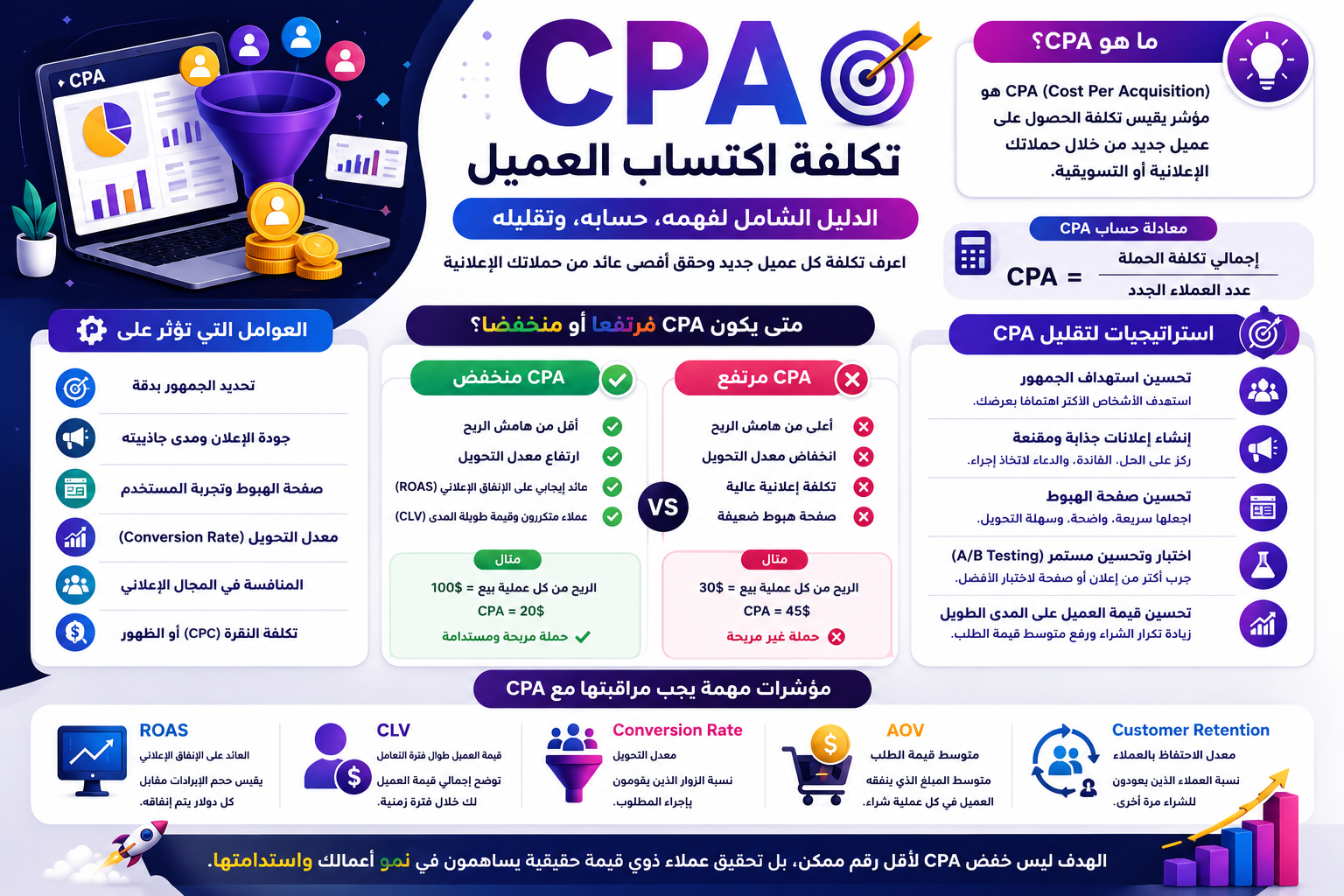
The Complete CPA Guide: What Is Cost Per Acquisition and How to Improve Your Advertising Campaign Performance
- Introduction
In digital marketing, the success of an advertising campaign is not measured solely by the number of clicks or impressions it generates, but by its ability to convert potential customers into actual paying customers at the lowest possible cost. This is where CPA (Cost Per Acquisition) becomes one of the most important Key Performance Indicators (KPIs), helping businesses and marketers evaluate the efficiency of their advertising spend and determine whether their campaigns are delivering the desired results.
CPA measures the average cost of acquiring a new customer, enabling marketers to assess campaign performance, optimize budgets, and make data-driven decisions that maximize return on investment. Whether you run an eCommerce store, offer professional services, or promote a mobile app or subscription-based business, understanding CPA is essential for achieving sustainable growth while keeping acquisition costs under control.
In this comprehensive guide, you'll learn what Cost Per Acquisition (CPA) is, how to calculate it, the key factors that influence it, and how it differs from other important marketing metrics such as CPC, CPM, and CAC. You'll also discover practical strategies to reduce your CPA, improve campaign performance, and explore real-world examples and case studies that make the concept easy to understand and apply.
What is CPA (Cost Per Acquisition)?
CPA (Cost Per Acquisition), or Cost Per Acquisition, is one of the most important Key Performance Indicators (KPIs) in digital marketing. It measures the average cost required to achieve a specific acquisition or conversion, such as completing a purchase, subscribing to a service, downloading an app, or submitting a registration form.
This metric is based on comparing the total advertising spend with the number of acquisitions or conversions achieved, helping marketers evaluate the efficiency of their advertising campaigns and make data-driven decisions to improve performance and increase Return on Investment (ROI).

- How Is CPA Calculated?
Cost Per Acquisition (CPA) is calculated by dividing the total advertising spend by the number of customers acquired or conversions generated during the campaign.
CPA Formula
CPA = Total Advertising Cost ÷ Number of Acquisitions (or Conversions)
For example, if a business spends $1,000 on an advertising campaign and acquires 20 new customers, the CPA would be:
CPA = $1,000 ÷ 20 = $50 per customer
This means the business spent an average of $50 to acquire each new customer.
It's important to note that an acquisition depends on the campaign objective. It could be a purchase, a new account registration, a completed lead form, a subscription, or an app download. Defining your conversion goal before measuring CPA ensures accurate and meaningful results.
- Customer Journey Before Calculating CPA
Cost Per Acquisition (CPA) is not calculated as soon as an advertisement is displayed. Instead, a customer goes through several stages before becoming a successful acquisition. Understanding this journey helps marketers identify weaknesses in their campaigns and optimize each stage to reduce acquisition costs and improve conversion rates.
A typical customer journey includes the following steps:
- Ad Impression: The customer sees your advertisement on platforms such as Google, Meta, or TikTok.
- Ad Click: The customer clicks the ad to learn more about your product or service.
- Landing Page Visit: They arrive at the landing page containing your offer.
- Content Engagement: They explore the page, read the information, and evaluate the offer.
- Conversion: The customer completes the desired action, such as making a purchase, signing up, or submitting a form.
- CPA Calculation: Once the conversion is completed, the acquisition cost is calculated by dividing the total advertising spend by the number of successful acquisitions.
What Does CPA Cost Mean?
CPA (Cost Per Acquisition) refers to the average amount a company spends to achieve one acquisition or conversion, based on the specific goal of the advertising campaign. This conversion could be a purchase, a service subscription, an app download, a registration, or any other action defined by the company as a campaign goal.
For example, if a company spends EGP 5,000 on an advertising campaign and generates 50 acquisitions, the calculation would be:
CPA = 5,000 ÷ 50 = EGP 100
This means that the company spent an average of EGP 100 to achieve each acquisition.
It is important to note that CPA does not represent the profit or loss generated from a customer. Instead, it only shows the cost of achieving the conversion. Therefore, campaign success should not be evaluated based on CPA alone. It should also be analyzed alongside metrics such as ROAS, AOV, and CLV, as well as the business's profit margin.
A low CPA does not necessarily mean that a campaign is profitable if the order value or profit margin is low. Conversely, a relatively high CPA may still be acceptable if the customer generates greater value and profit over the long term.
- Practical Examples of Calculating CPA
After understanding how Cost Per Acquisition (CPA) is calculated, let's look at a few practical examples from different industries.
Example 1: eCommerce Store
An online store spent EGP 10,000 on a social media advertising campaign and generated 100 purchases.
Calculation:
CPA = 10,000 ÷ 100 = EGP 100 per customer
This means the store spent an average of EGP 100 to acquire each new customer.
- How Do You Know If Your CPA Is High or Acceptable?
There is no universal benchmark for a good or bad CPA, as acquisition costs vary depending on the industry, product or service value, competition, and campaign objectives. A CPA should be evaluated based on its profitability rather than its absolute value.
For example, a $50 CPA may be too high for a product that sells for $80, but it could be an excellent result for a service worth $500 or a subscription that generates recurring revenue.
The following table can help you assess your CPA performance:
CPA Situation What It Means Low CPA with a high conversion rate Your campaign is efficiently acquiring customers at a reasonable cost. Low CPA with low profitability Customers may have a low purchase value or poor quality, so a low CPA alone doesn't guarantee success. High CPA with high profits This can be acceptable if the customer's lifetime value exceeds the acquisition cost. High CPA with low sales Usually indicates issues with targeting, ads, or the landing page that require optimization.To accurately evaluate CPA, always compare it with other marketing metrics such as Conversion Rate, ROAS (Return on Ad Spend), and Customer Lifetime Value (LTV) rather than relying on CPA alone.
- 7 Reasons Why Your CPA Increases (And How to Fix It)
A high Cost Per Acquisition (CPA) can result from several factors that reduce campaign efficiency and lower conversion rates. Identifying the root cause is the first step toward reducing acquisition costs and improving overall performance.
1. Poor Audience Targeting
Problem: Your ads are reaching people who are not interested in your product or service.
Solution: Refine your audience using demographics, interests, behaviors, lookalike audiences, and remarketing.
2. Low-Quality Ads
Problem: Your ad copy or creatives fail to capture attention or encourage action.
Solution: Create compelling ads with strong headlines, engaging visuals, and a clear call to action.
3. Ineffective Landing Page
Problem: A slow, confusing, or poorly designed landing page discourages conversions.
Solution: Improve page speed, simplify the design, and make your offer and CTA clear.
4. Low Conversion Rate
Problem: Many visitors but very few conversions.
Solution: Optimize your landing page through A/B testing and improve the user experience.
5. High Competition
Problem: Increased competition raises advertising costs.
Solution: Target less competitive audiences, use long-tail keywords, and diversify your marketing channels.
6. Poor Conversion Tracking
Problem: Incorrect tracking setup leads to inaccurate campaign data.
Solution: Properly configure and regularly test your analytics and conversion tracking tools.
7. Lack of Campaign Optimization
Problem: Campaigns are left running without continuous analysis or improvements.
- Does a Low CPA Mean a Successful Campaign?
A low CPA (Cost Per Acquisition) does not always mean that an advertising campaign is successful. Although a lower customer acquisition cost is a positive indicator, it does not fully reflect customer quality or the long-term profitability of the campaign.
A campaign may achieve a low CPA, but still fail to deliver real business growth for several reasons:
1. Customers Do Not Purchase Again (Low Customer Retention)
A campaign may attract many new customers at a low cost, but if these customers do not return for future purchases, their overall value remains limited and the business cannot achieve sustainable growth.
2. Low Average Order Value (AOV)
A business may acquire customers at a low cost, but if customers only make small purchases, the generated revenue may not be enough to cover advertising costs and achieve a strong return.
3. Poor Customer Quality
Some campaigns may attract customers who are not a good fit for the product or service. For example, customers who only respond to discounts and offers without having a real intention to purchase again or build a long-term relationship with the brand.
Therefore, campaign success should not be measured by CPA alone. It should be analyzed alongside other important metrics such as:
- Customer Lifetime Value (CLV): Measures the total value a customer generates throughout their relationship with the business.
- Return on Ad Spend (ROAS): Measures the revenue generated from advertising investment.ROAS
- Customer Retention Rate: Shows the ability of a business to keep customers and encourage repeat purchases.
Case Study: Clothing Brand CPA Optimization Before and After Improving Landing Page and Ads
Before Optimization
A clothing brand was using paid advertising to attract customers but faced several challenges that increased its CPA (Cost Per Acquisition):
- High CPA: Due to poor audience targeting and reaching users with low purchase intent.
- Poor Landing Page: The product page lacked professional images, clear product details, sizing information, and customer trust elements.
- Low Conversion Rate: Many visitors clicked on the ads but left without completing purchases.
- Unoptimized Ads: Ads focused only on showing products without highlighting benefits or strong reasons to buy.
Results Before Optimization:
- Higher advertising costs.
- Fewer conversions.
- Higher CPA.
- Lower-quality customers.
The company improved both the landing page and advertising campaigns:
1. Landing Page Optimization
Improvements included:
- Adding professional product images from multiple angles.
- Creating clear product descriptions focused on benefits and quality.
- Adding customer reviews and testimonials.
- Improving page speed.
- Simplifying the checkout process.
2. Ad Optimization
The company improved ads by:
- Targeting the right audience based on interests and buying behavior.
- Testing different creatives and ad copies.
- Creating stronger headlines that communicate product value.
- Using customer-focused content to build trust.
Results After Optimization
After improving the landing page and ads, the company achieved:
- Lower CPA due to higher conversion rates.
- More purchases with the same advertising budget.
- Better customer quality.
- Higher average order value.
- Improved ROAS.
Common Mistakes Marketers Make When Tracking CPA
Although CPA (Cost Per Acquisition) is one of the most important metrics for evaluating advertising performance, using it incorrectly can lead to poor marketing decisions. Marketers often make several mistakes when analyzing and tracking CPA:
1. Focusing Only on a Low CPA
Some marketers assume that a lower customer acquisition cost always means a successful campaign. However, low CPA customers may not be profitable or may not make repeat purchases.
CPA should always be analyzed with other metrics such as CLV and ROAS to understand the real customer value.
2. Ignoring Customer Quality
A campaign may generate many customers at a low cost, but if these customers are not interested in the product or do not become loyal customers, the low CPA does not represent real success.
3. Comparing CPA Between Different Campaigns Without Context
A common mistake is comparing CPA across campaigns without considering:
- Target audience.
- Product price.
- Customer journey stage.
- Campaign objective.
A campaign with a higher CPA may actually generate more valuable customers.
4. Ignoring Conversion Rate
Some marketers focus only on advertising costs and overlook the conversion rate of visitors into customers.
A high CPA may be caused by problems with the landing page or user experience rather than the advertisement itself.
5. Not Updating Data and Analysis Regularly
Relying on old data or analyzing CPA over a very short period can lead to inaccurate conclusions because customer behavior and advertising costs constantly change.
6. Not Segmenting Data Properly
Tracking overall CPA only can hide important insights. Marketers should analyze CPA by:
- Advertising platform (Facebook, Google, TikTok).
- Target audience.
- Campaign.
- Product category.
This helps identify the most profitable campaigns.
Checklist Before Launching Any Advertising Campaign
Before launching any advertising campaign, marketers should ensure that all elements affecting CPA (Cost Per Acquisition) are ready. Campaign success depends not only on the advertisement itself but also on the complete customer journey from seeing the ad to completing the purchase.
1. Define Campaign Objective
Before starting, define the main campaign goal:
- Increase sales?
- Generate leads?
- Drive sign-ups?
- Build brand awareness?
Choosing the right objective helps advertising platforms reach the most relevant audience.
2. Define Target Audience
Make sure the campaign targets potential customers by:
- Defining the right demographics.
- Understanding interests and buying behavior.
- Analyzing existing customers.
- Creating Custom and Lookalike Audiences.
3. Review The Offer
Ensure that the offer is clear and attractive:
- Is the price competitive?
- Is there a clear value proposition?
- Does the offer provide a strong reason to buy?
- Are the terms clear?
4. Prepare Landing Page or Product Page
The landing page directly affects CPA, so check:
- Page loading speed.
- Clear product images.
- Persuasive descriptions.
- Customer reviews.
- Easy checkout process.
- Mobile optimization.
5. Test Ad Creatives
Prepare multiple ad variations and test:
- Different designs.
- Headlines.
- Ad copies.
- Images and videos.
This helps identify the best-performing ads with lower CPA and higher-quality customers.
6. Set Up Tracking and Analytics
Before launching, ensure:
- Tracking pixels or Conversion API are installed.
- Conversions are recorded correctly.
- Analytics tools are connected.
Accurate data helps marketers make better decisions.
7. Plan Budget and Testing Strategy
Set a suitable testing budget and define:
- Target CPA.
- Testing duration.
- Success metrics.
8. Review Key Performance Indicators (KPIs)
Do not track CPA alone. Monitor:
- CPA: Cost Per Acquisition.
- Conversion Rate: Percentage of visitors who convert.
- ROAS: Return on Ad Spend.
- AOV: Average Order Value.
- CLV: Customer Lifetime Value.
How to Reduce CPA in 30 Days
Reducing CPA (Cost Per Acquisition) is not only about lowering advertising spend. It requires optimizing the entire customer journey, from the advertisement to the final purchase. A structured 30-day plan can help businesses improve campaign performance and reduce customer acquisition costs.
Week 1: Analyze Current Performance (Audit & Analysis)
Start by identifying why CPA is high:
- Review current campaigns and identify high-cost campaigns.
- Analyze audience performance.
- Review targeting settings and customer segments.
- Analyze landing pages and conversion issues.
- Track key metrics such as:
- Current CPA.
- Conversion Rate.
- Average Order Value (AOV).
- Return on Ad Spend (ROAS).
Goal: Identify where budget is being wasted before making improvements.
Week 2: Optimize Ads and Audience Targeting
Improve campaigns by:
1. Improve Audience Targeting
- Remove low-performing audiences.
- Focus on high-intent customers.
- Test Lookalike Audiences.
- Use existing customer data to create Custom Audiences.
2. Test Ad Creatives
Create and test different versions of:
- Images and videos.
- Headlines.
- Marketing messages.
- Offers.
Goal: Increase conversion rates and reduce acquisition costs.
Week 3: Optimize Landing Page & Customer Experience
A strong advertisement can still fail if the landing page is weak.
Improve the page by:
- Increasing page speed.
- Optimizing mobile experience.
- Adding better product images and videos.
- Writing benefit-focused descriptions.
- Adding customer reviews.
- Simplifying checkout steps.
Goal: Convert more visitors into customers.
Week 4: Scale and Continuous Optimization
After identifying the best-performing campaigns:
- Gradually increase budgets for successful campaigns.
- Stop elements that increase CPA.
- Retarget users who did not complete purchases.
- Compare results before and after optimization.
Monitor key metrics:
- CPA: Cost Per Acquisition.
- ROAS: Return on Ad Spend.
- CLV: Customer Lifetime Value.
- Retention Rate: Customer Retention.
The Future of CPA with Artificial Intelligence
With the growth of Artificial Intelligence (AI), measuring and optimizing CPA (Cost Per Acquisition) has become more accurate and intelligent. Marketers are no longer relying only on historical data; AI systems can now predict customer behavior and continuously optimize campaigns to achieve better results at a lower cost.
1. AI-Powered Customer Targeting
AI analyzes large amounts of customer data, including interests, purchasing behavior, and previous interactions, to identify users with the highest probability of conversion.
This helps businesses:
- Reach the right audience.
- Reduce wasted ad spend.
- Improve customer quality and lower CPA.
2. Predictive Customer Analysis
AI tools can predict which customers are more likely to purchase or make repeat purchases, allowing businesses to focus on valuable customers rather than simply increasing the number of conversions.
The focus shifts from:
Lowering CPA only → Increasing Customer Value.
3. AI-Based Ad Optimization
Advertising platforms use AI to analyze campaign performance and automatically optimize:
- Images and videos.
- Ad copy.
- Target audiences.
- Delivery times.
This improves conversion rates and reduces acquisition costs.
4. Personalized Marketing
AI helps businesses create personalized advertising messages based on customer behavior and needs.
Example:
A customer who viewed a product but did not purchase may receive a different message than an existing customer.
This increases conversions and improves CPA.
5. Moving from CPA to Customer Lifetime Value
In the future, success will not depend only on acquiring customers at the lowest cost, but on acquiring the most valuable customers.
Businesses will focus more on combining:
- CPA: Cost Per Acquisition.
- CLV: Customer Lifetime Value.
- ROAS: Return on Ad Spend.
- Retention Rate: Customer Retention.
Factors Affecting CPA
CPA (Cost Per Acquisition) is influenced by many factors that determine the cost of acquiring a new customer. A higher or lower CPA is not only related to advertising budget but also depends on ad quality, targeting, and the overall customer experience.
1. Ad Quality
Ad quality has a direct impact on CPA. Ads with clear messaging and strong engagement usually achieve higher conversion rates and lower acquisition costs.
Key factors include:
- Strong headlines.
- High-quality images or videos.
- Clear offers.
- Relevance to the target audience.
2. Audience Targeting
Choosing the right audience is one of the most important factors affecting CPA.
When ads reach users who are genuinely interested:
- Conversion probability increases.
- Conversion rates improve.
- CPA decreases.
Poor targeting can waste advertising budget on uninterested users.
3. Conversion Rate
The higher the percentage of visitors who become customers, the lower the CPA.
Conversion rate is affected by:
- Landing page design.
- Checkout experience.
- Clear information.
- Brand trust.
4. Landing Page Experience
Landing pages have a major impact on acquisition costs.
Important factors include:
- Page speed.
- Mobile optimization.
- Quality content and visuals.
- Customer reviews.
- Clear Call-To-Action (CTA).
5. Market Competition
Higher competition for the same audience or keywords increases advertising costs, which can lead to a higher CPA.
6. Offer Quality
A strong offer can increase conversions and reduce CPA.
Examples:
- Competitive pricing.
- Discounts.
- Free shipping.
- Guarantees and return policies.
7. Budget and Bidding Strategy
Budget allocation and bidding strategies directly affect acquisition costs.
Poor strategies may result in:
- Higher cost per result.
- Limited reach.
- Poor campaign performance.
8. Customer Journey Stage
CPA varies depending on where customers are in the buying journey.
New customers usually require more effort, while existing brand-aware customers are easier to convert.
9. Data Quality and Analytics
Accurate data helps optimize CPA by identifying:
- Best-performing campaigns.
- Most valuable audiences.
- Highest-converting products.
Difference Between CPA, CPC, CPM, and CPL
Digital marketing metrics vary depending on the campaign objective. Some measure the cost of reaching an audience, while others measure clicks, leads, or actual customers.
1. CPA (Cost Per Acquisition)
CPA measures how much a business spends to acquire a customer who completes a desired action, such as purchasing a product or subscribing to a service.
Formula:
CPA = Total Advertising Spend ÷ Number of Acquired Customers
Used for:
- Increasing sales.
- Acquiring new customers.
- Measuring campaign profitability.
2. CPC (Cost Per Click)CPC
CPC measures the cost paid for each click on an advertisement.
Formula:
CPC = Total Advertising Spend ÷ Number of Clicks
Used for:
- Increasing website traffic.
- Driving users to learn more.
- Measuring ad engagement.
3. CPM (Cost Per Mille)CPM
CPM measures the cost of 1,000 ad impressions, regardless of clicks or purchases.
Formula:
CPM = (Total Advertising Spend ÷ Impressions) × 1000
Used for:
- Brand awareness.
- Increasing reach.
- Building market visibility.
4. CPL (Cost Per Lead)
CPL measures the cost of acquiring a potential customer who provides information such as email, phone number, or inquiry request.
Formula:
CPL = Total Advertising Spend ÷ Number of Leads
Used for:
- Lead generation.
- Collecting customer information.
- Building sales pipelines.
? What Is the Average CPC
CPC (Cost Per Click) is the amount a business pays for each click on an advertisement. There is no fixed average CPC because it varies depending on the advertising platform, industry, target audience, location, and competition level.
Generally, average CPC ranges can be:
- Meta Ads (Facebook & Instagram): Around $0.20–$1 per click on average, depending on the campaign.
- Google Search Ads: Often around $1–$5 per click, with higher costs in competitive industries.
- TikTok Ads: Often lower-cost compared to some platforms, depending on targeting and objectives.
Factors Affecting Average CPC:
1. Industry
Competitive industries usually have higher CPC because more advertisers compete for the same audience.
2. Ad Quality
Higher-quality ads with better engagement can achieve lower CPC because platforms prioritize relevant and useful content.
3. Target Audience
Highly valuable audiences may have higher CPC due to increased competition.
4. Advertising Platform
CPC differs between Google, Meta, TikTok, and other platforms based on user behavior and advertising systems.
5. Campaign Objective
Campaigns focused on sales or conversions may have higher CPC but can generate more valuable results.
? Does a Low CPC Mean a Successful Campaign
Not always. A low-cost click does not guarantee sales or high-quality leads.
CPC should be analyzed with other metrics such as:
- CPA (Cost Per Acquisition)
- Conversion Rate
- ROAS (Return on Ad Spend)
- CLV (Customer Lifetime Value)
Reducing CPC (Cost Per Click) is not only about spending less on ads. It requires improving ad quality and increasing relevance to the target audience. When ads provide a better user experience, businesses can achieve more clicks at a lower cost.
1. Improve Ad Quality
High-quality ads usually achieve better engagement and lower CPC.
Improve ad quality by:
- Using attractive images and videos.
- Creating clear and compelling headlines.
- Delivering messages that match audience needs.
- Highlighting customer benefits.
2. Optimize Audience Targeting
Reaching the right audience helps reduce wasted clicks and improve CPC.
Use:
- Customer data analysis.
- Custom Audiences.
- Lookalike Audiences.
- Audience exclusions.
3. Increase Ad Engagement
Higher engagement can improve campaign performance and reduce click costs.
Strategies include:
- Testing different creatives.
- Using engaging short videos.
- Testing multiple headlines.
- Creating stronger offers.
4. Improve Quality Score (Google Ads)
In Google Ads, Quality Score affects CPC. Higher-quality ads can achieve lower costs.
Improve it through:
- Relevant keywords.
- Better ad copy.
- Optimized landing pages.
- Higher CTR.
5. Optimize Landing Page Experience
A good landing page improves campaign performance.
Focus on:
- Fast loading speed.
- Mobile optimization.
- Clear information.
- Strong Call-To-Action (CTA).
6. Run Continuous A/B Testing
Test different elements:
- Images.
- Videos.
- Copy.
- Headlines.
- Audiences.
7. Avoid Highly Competitive Targeting
High competition increases CPC.
Reduce costs by:
- Using long-tail keywords.
- Testing less competitive audiences.
- Exploring new targeting opportunities.
Measuring CPC (Cost Per Click) requires tools that track click costs, traffic quality, and conversions generated from advertising campaigns. The right tool depends on the advertising platform and campaign type.
1. Google Ads Google Ads
Google Ads is one of the most important tools for measuring CPC, especially for search campaigns.
It provides:
2. Meta Ads ManagerMeta
Used to measure Facebook and Instagram advertising performance.
It provides:
3. Google Analytics 4 (GA4)Google Analytics 4 (GA4)
GA4 helps analyze what happens after users click an advertisement.
It measures:
- Traffic quality.
- User behavior.
- Pages visited.
- Conversions and sales.
4. TikTok Ads ManagerTikTok Ads Manager
Tracks TikTok campaign performance, including:
5. LinkedIn Campaign ManagerLinkedIn Campaign Manager
Useful for B2B campaigns and professional audiences.
It helps measure:
- Click costs.
- Audience quality.
- Campaign performance.
6. Keyword Research ToolsGoogle Keyword Planner
Tools such as:
- Google Keyword Planner.
- SEMrush.
- Ahrefs.
Help analyze:
- Keyword CPC estimates.
- Competition levels.
- Lower-cost targeting opportunities.
Common Mistakes That Increase CPA
A high CPA (Cost Per Acquisition) is not always caused by expensive ads. It can result from mistakes in targeting, strategy, customer experience, or campaign optimization.
1. Wrong Audience Targeting
Showing ads to people who are unlikely to buy can significantly increase CPA.
Common causes:
- Broad targeting.
- Lack of customer data analysis.
- Ignoring purchase behavior.
- Not using Custom Audiences.
2. Poor Ad Quality
Low-quality ads reduce engagement and increase acquisition costs.
Common issues:
- Weak visuals.
- Unclear messaging.
- Lack of customer benefits.
- Weak offers.
3. Poor Landing Page Experience
A successful ad can still fail if the landing page does not convert visitors.
Common problems:
- Slow loading speed.
- Poor mobile experience.
- Unclear product information.
- Lack of trust elements.
- Complicated checkout process.
4. Not Testing Ads
Running only one version of an ad limits optimization opportunities.
Marketers should test:
- Creatives.
- Headlines.
- Ad copy.
- Audiences.
- Offers.
5. Focusing Only on CPA and Ignoring Customer Quality
A lower CPA does not always mean better results.
Analyze CPA with:
- CLV
- ROAS
- Repeat purchase rate.
6. Poor Data Analysis
Without regular performance analysis, businesses may continue spending on ineffective campaigns.
Monitor:
- Best and worst campaigns.
- Conversion sources.
- Audience performance.
- Most profitable products.
7. Ignoring Retargeting
Many customers do not purchase on their first visit. Retargeting helps recover potential customers at a lower acquisition cost.
8. Wrong Bidding Strategy
Choosing the wrong bidding strategy can increase CPA.
The strategy should match:
- Campaign objective.
- Customer journey stage.
- Available data.
Relationship Between CPA and Other Marketing KPIs
CPA (Cost Per Acquisition) is one of the most important digital marketing metrics, but it does not provide a complete picture of campaign performance when analyzed alone. It should be evaluated alongside other key performance indicators (KPIs) to understand campaign efficiency, customer quality, and overall profitability.
1. CPA and Conversion Rate
CPA has a direct relationship with the Conversion Rate.
A higher conversion rate usually leads to a lower CPA because more visitors complete the desired action without increasing advertising costs.
2. CPA and ROAS
ROAS (Return on Ad Spend) measures the revenue generated from advertising, while CPA measures the cost of acquiring a customer.
A campaign may have a low CPA but still generate poor ROAS if customer revenue is low.
3. CPA and CLV
Customer Lifetime Value (CLV) measures the total value a customer generates over time.
A higher CPA may still be profitable if customers continue making repeat purchases and generate long-term revenue.
4. CPA and CTR
CTR (Click-Through Rate) measures how many users click an advertisement after seeing it.
A high CTR often indicates a relevant and engaging ad, but it does not guarantee a low CPA unless those clicks convert into customers.
5. CPA and CPC
CPC (Cost Per Click) measures the cost of each click, while CPA measures the cost of acquiring an actual customer.
A campaign can have a low CPC but still suffer from a high CPA if visitors do not convert.
6. CPA and AOV
Average Order Value (AOV) measures the average amount spent per order.
A higher CPA may still be acceptable if customers place high-value orders that generate strong profits.
When Is CPA Considered High or Low?
There is no universal benchmark for a high or low CPA (Cost Per Acquisition) because it depends on the industry, product price, profit margin, customer value, and campaign objectives. CPA should always be evaluated within the context of business profitability.
? When Is CPA Low
A CPA is considered low when a business acquires customers at a cost that allows it to generate healthy profits while maintaining customer quality.
Signs of a healthy low CPA include:
- Customer acquisition cost is lower than the profit margin.
- Customers make repeat purchases.
- High conversion rate.
- Strong Return on Ad Spend (ROAS).
- High Customer Lifetime Value (CLV).
Example:
If a business earns $100 in profit from each sale and its CPA is $20, the acquisition cost is considered efficient and profitable.
? When Is CPA High
CPA becomes high when acquiring a customer costs more than the business can afford while maintaining profitability.
Common reasons include:
- Poor audience targeting.
- Low conversion rates.
- High advertising competition.
- Weak landing pages.
- Poor ad quality.
- High CPC.
Example:
If the average profit per sale is $30, but the CPA is $45, the business loses $15 for every new customer acquired.
? Is a Lower CPA Always Better
Not necessarily.
A campaign may have a low CPA, but:
- Customers never purchase again.
- Average Order Value (AOV) is low.
- Customers only buy during discounts.
- Customer Lifetime Value (CLV) is low.
CPA should always be analyzed alongside:
- ROAS
- CLV
- Conversion Rate
- Customer Retention Rate
- Average Order Value (AOV)
- Conclusion
CPA (Cost Per Acquisition) is one of the most important marketing metrics for measuring the cost of acquiring new customers and evaluating advertising campaign performance. However, campaign success is not determined by achieving the lowest CPA alone. Businesses must balance acquisition costs with customer quality, long-term value, and overall profitability.
To maximize results, companies should optimize every stage of the customer journey, from audience targeting and ad creatives to landing page experience and conversion optimization. In addition, CPA should always be analyzed alongside other key metrics such as ROAS, CLV, Conversion Rate, and Average Order Value (AOV) to gain a complete understanding of campaign performance.
Ultimately, the goal is not simply to reduce CPA, but to acquire high-value customers who contribute to sustainable business growth. Through continuous testing, data analysis, and campaign optimization, businesses can improve marketing efficiency, maximize return on investment, and achieve long-term success.