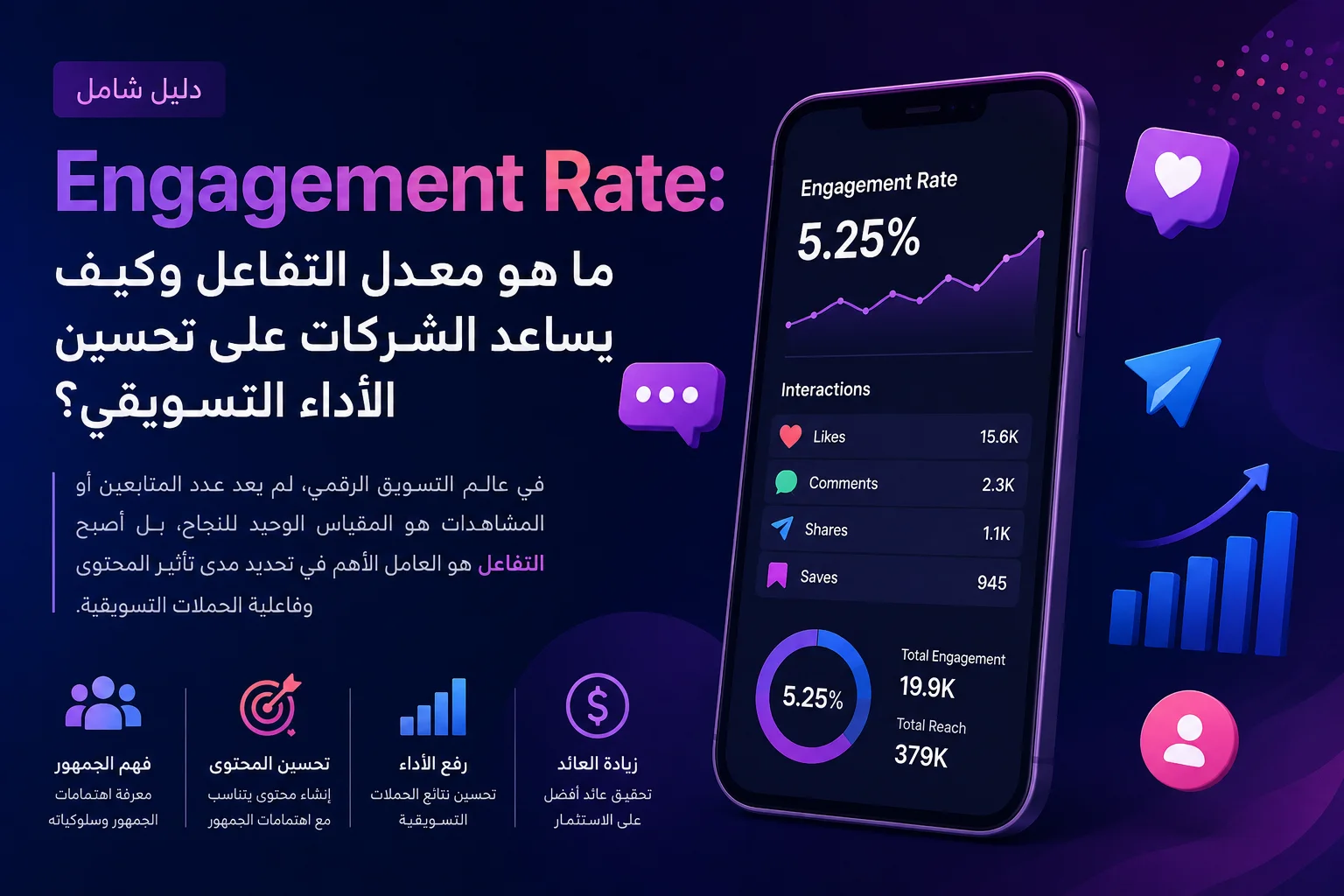
Engagement Rate is one of the most important performance indicators that companies and marketers rely on to understand the success of digital content and its ability to attract audience attention. In the world of digital marketing, it is not enough to measure only the number of views or followers. It has become essential to measure how the actual audience interacts with the brand through likes, comments, shares, clicks, and other forms of engagement.
Engagement Rate does not only reflect the size of the audience, but also shows the strength of the relationship between the brand and its customers, as well as the ability of content to capture interest and encourage users to take positive actions. Therefore, companies use this metric to evaluate content quality, improve marketing strategies, and gain a deeper understanding of customer behavior.
Analyzing Engagement Rate also helps companies make data-driven decisions, identify the most effective types of content, optimize marketing campaigns, and increase the chances of converting followers into actual customers. Engagement Rate is directly connected to several important marketing metrics such as Conversion Rate, ROAS, LTV, and Customer Retention, making it a key element in measuring the success of digital activities.
With the increasing competition across digital platforms, the most successful brands are those that do not only focus on reaching the largest number of people, but also prioritize building genuine and continuous engagement with their audience and transforming this interaction into loyalty, trust, and sustainable business growth.
What is Engagement Rate?Engagement Rate is one of the most important performance indicators in digital marketing. It is a metric that shows how much the audience interacts with content or a brand compared to the number of people who viewed or reached the content.
This metric reflects the level of audience interest in the content and its ability to capture attention and encourage users to take actions such as likes, comments, shares, saves, link clicks, or watching and interacting with videos.
Engagement Rate does not depend only on the number of followers or views, but focuses on the quality of the relationship between the brand and its audience. A brand may have a large number of followers, but its Engagement Rate can still be low if the audience is not interested in the content or does not actively interact with it.
Learn how Meta measures content performance, audience engagement, and advertising effectiveness across Facebook and Instagram:Meta Business
Engagement Rate Calculation FormulaThe Engagement Rate is commonly calculated using the following formula:
Engagement Rate = (Total Number of Engagements ÷ Number of People Reached) × 100
Engagements usually include:
- Likes
- Comments
- Shares
- Saves
- Clicks
- Video Views & Interactions
If a company publishes content that receives:
- 800 Likes
- 100 Comments
- 100 Shares
And the number of people who viewed the content is 25,000 people:
Total Engagements = 1,000 interactions
Engagement Rate = (1,000 ÷ 25,000) × 100 = 4%
This means that 4% of the people who viewed the content interacted with it.
Why is Engagement Rate Important?Engagement Rate helps companies understand how successful their content is and determine whether marketing campaigns are reaching the right audience or not.
The key benefits include:
Explore expert guides on content marketing, social media engagement, customer relationships, and digital marketing strategies HubSpot
1. Measuring Content Quality
It helps identify the types of content that generate the best audience response and achieve higher levels of interaction.
2. Understanding Customer Behavior
It reveals audience interests, preferences, and the types of content they find most valuable.
3. Improving Marketing Strategies
It helps companies develop better content and marketing campaigns based on actual data and audience behavior.
4. Increasing Customer Loyalty
Continuous engagement strengthens the relationship between customers and the brand, increasing trust and long-term loyalty.
5. Improving Advertising Performance
It helps evaluate how effectively advertisements attract the target audience and whether they generate meaningful interactions.
The Importance of Engagement Rate for BusinessesEngagement Rate is one of the most important metrics that helps companies measure the success of their digital strategies and understand the relationship between the brand and its audience. It does not only focus on the number of people who view the content, but also measures their level of interest and actual interaction, providing deeper insights into content performance and customer behavior.
Google Analytics helps businesses track user behavior, engagement, conversions, and website performance through detailed analytics:Google Analytics
1. Measuring Content QualityEngagement Rate helps companies understand how successful their content is in attracting audience attention. A piece of content may achieve a large number of views but fail to generate real engagement, which indicates the need to improve the message or the way the content is presented.
By analyzing Engagement Rate, companies can identify:
- The most effective types of content.
- Topics that attract audience interest.
- The strategies that achieve the best response.
Engagement Rate provides valuable data that helps companies better understand their audience, including:
- Products or services that customers are interested in.
- Types of content they prefer.
- Platforms where they interact the most.
- Their needs and expectations.
This helps brands create content that is more relevant and connected to their audience.
3. Improving Digital Marketing StrategiesAnalyzing Engagement Rate helps companies develop their marketing plans based on real data rather than assumptions.
By identifying the most successful content, companies can:
- Improve marketing campaigns.
- Choose the most effective communication channels.
- Increase content effectiveness.
- Achieve better results from marketing budgets.
Continuous engagement is not only about increasing numbers; it also helps build a stronger relationship between customers and the brand.
When customers feel that the brand communicates with them and provides valuable content, they are more likely to:
- Continue following the brand.
- Make repeat purchases.
- Increase their trust in the company.
- Become loyal customers.
Engagement Rate helps evaluate how successful digital advertisements are in attracting the target audience.
A high Engagement Rate may indicate:
- A strong advertising message.
- Relevant content for the audience.
- Successful ad targeting.
It also helps companies improve future campaigns and reduce spending on ineffective content.
6. Increasing the Chances of Converting the Audience into CustomersThe more the audience interacts with the brand, the more likely they are to move from the interest stage to taking actual actions such as:
- Visiting the website.
- Subscribing to a service.
- Requesting a product.
- Completing a purchase.
Therefore, Engagement Rate is an important step in the customer conversion journey.
7. Enhancing Brand AwarenessContent that receives high engagement has a greater chance of reaching a wider audience, especially when users share it with others.
This leads to:
- Increasing brand visibility.
- Attracting new customers.
- Strengthening the company’s position in the market.
Engagement Rate provides valuable insights that help companies make more accurate decisions regarding:
- Content strategy.
- Marketing budgets.
- Future campaigns.
- Customer needs.
Therefore, Engagement Rate becomes a strategic tool that helps businesses improve performance, strengthen customer relationships, and achieve sustainable growth.
How to Calculate Engagement Rate?Engagement Rate is calculated to measure the percentage of audience interaction with content compared to the number of people who viewed or reached the content. This metric is used to evaluate how effective content is in attracting audience attention and encouraging users to engage with it.
The Basic Formula for Calculating Engagement Rate
Engagement Rate = (Total Number of Engagements ÷ Number of People Reached) × 100
Where total engagements include:
- Likes
- Comments
- Shares
- Saves
- Clicks
- Video Views & Interactions
Assume a company publishes content that receives:
- 800 Likes
- 100 Comments
- 100 Shares
Total Engagements:
800 + 100 + 100 = 1,000 engagements
The number of people who viewed the content:
25,000 people
Applying the formula:
Engagement Rate = (1,000 ÷ 25,000) × 100
Engagement Rate = 4%
This means that 4% of the people who viewed the content interacted with it.
Different Ways to Calculate Engagement RateThe calculation method may vary depending on the platform and the purpose of analysis. The most common methods include:
1. Engagement Rate by Reach (ERR)
This is one of the most commonly used methods. It calculates engagement based on the number of people who actually saw the content.
Formula:
Engagement Rate = (Total Engagements ÷ Total Reach) × 100
It provides an accurate measurement of how engaged the audience is after viewing the content.
2. Engagement Rate by Followers
This method calculates engagement compared to the total number of followers.
Formula:
Engagement Rate = (Total Engagements ÷ Number of Followers) × 100
It helps measure how active and engaged the existing audience is with the brand.
3. Engagement Rate by Impressions
This measures engagement compared to the total number of times the content was displayed.
Formula:
Engagement Rate = (Total Engagements ÷ Total Impressions) × 100
It is commonly used when analyzing the performance of paid advertising campaigns.
4. Engagement Rate by Views
This method is mainly used for video content.
Formula:
Engagement Rate = (Total Engagements ÷ Total Views) × 100
It helps measure the effectiveness of videos and their ability to attract and engage viewers.
Why Should Companies Calculate Engagement Rate?Measuring Engagement Rate helps companies:
- Identify the most successful and impactful content.
- Improve content strategies.
- Understand audience interests and preferences.
- Evaluate marketing campaign performance.
- Compare results across different platforms.
- Improve marketing return on investment (ROI).
Therefore, Engagement Rate is not just a numerical percentage; it is a strategic indicator that helps businesses understand the strength of their relationship with their audience and measure the success of their digital marketing efforts.
Types of Engagement RateThere are several types of Engagement Rate that differ based on how engagement is measured and the purpose of analysis. Companies and marketers use these metrics to better understand content performance and evaluate how audiences interact with their brands.
1. Engagement Rate by Reach (ERR)
This is one of the most commonly used engagement metrics. It measures the percentage of people who interacted with the content compared to the total number of people who actually reached the content.
Formula:
Engagement Rate by Reach = (Total Engagements ÷ Total Reach) × 100
Example:
If content reaches 20,000 people and receives 1,000 engagements:
ERR = (1,000 ÷ 20,000) × 100 = 5%
It helps measure how effective the content is among people who actually viewed it.
2. Engagement Rate by Followers
This metric measures audience engagement compared to the total number of followers.
Formula:
Engagement Rate by Followers = (Total Engagements ÷ Total Followers) × 100
Example:
If an account has 50,000 followers and a post receives 2,500 engagements:
Engagement Rate = (2,500 ÷ 50,000) × 100 = 5%
It helps measure audience activity and connection with the brand.
3. Engagement Rate by Impressions
This measures engagement compared to the total number of times content was displayed.
Formula:
Engagement Rate by Impressions = (Total Engagements ÷ Total Impressions) × 100
Example:
If an advertisement receives 100,000 impressions and generates 3,000 engagements:
Engagement Rate = (3,000 ÷ 100,000) × 100 = 3%
It is commonly used to analyze paid advertising campaign performance.
4. Engagement Rate by Views
This type is mainly used for video content. It measures engagement compared to the total number of views.
Formula:
Engagement Rate by Views = (Total Engagements ÷ Total Views) × 100
Example:
If a video receives 100,000 views and generates 8,000 engagements:
Engagement Rate = (8,000 ÷ 100,000) × 100 = 8%
It helps evaluate the ability of videos to attract and engage viewers.
5. Engagement Rate by Post
This measures the performance of each individual post to identify which content achieves the best results.
Formula:
Engagement Rate by Post = (Total Engagements on Post ÷ Total Followers) × 100
It is used to compare different posts and identify the most successful content formats.
6. Daily Engagement Rate
This measures audience engagement with an account during a specific period, such as a day or a week.
Formula:
Daily Engagement Rate = (Daily Engagements ÷ Total Followers) × 100
It helps track audience activity and identify the best times for publishing content.
Factors Affecting Engagement RateEngagement Rate is influenced by several factors that determine how successful content is in attracting audiences and encouraging them to interact. A high engagement rate does not depend on a single factor; instead, it results from a combination of content quality, audience behavior, and brand strategy.
The most important factors include:
1. Content Quality
Content quality is one of the most important factors affecting Engagement Rate. The more useful, attractive, and relevant the content is, the more likely users are to interact through likes, comments, and shares.
Content quality includes:
- Providing valuable and useful information.
- Using attractive images and videos.
- Having a clear marketing message.
- Solving audience problems.
2. Audience Relevance
The more relevant content is to audience interests and needs, the higher the engagement rate will be.
Understanding the audience helps companies identify:
- Preferred content types.
- Topics that interest customers.
- The best communication approach.
3. Platform Selection
Engagement levels vary across platforms depending on audience behavior.
For example:
- Short videos may perform better on TikTok and Instagram.
- Professional content may achieve higher engagement on LinkedIn.
- Educational long-form content may work better on blogs and websites.
Choosing the right platform helps brands reach the most relevant audience.
4. Posting Time
Publishing time directly affects engagement levels. Sharing content when the audience is most active increases the chances of reach and interaction.
Analytics tools help identify:
- Best posting times.
- Days when audiences are most active.
- User behavior across platforms.
5. Headline and First Impression
The first few seconds influence whether users continue viewing content or ignore it.
Using:
- Attractive headlines.
- Strong visuals.
- Engaging video openings.
Helps capture audience attention and increase engagement.
6. Call To Action (CTA)
Encouraging users to take a specific action can increase engagement.
Examples:
- Share your opinion in the comments.
- Share this content with others.
- Save this post for later.
- Share your experience with us.
A clear CTA increases the likelihood of audience response.
7. Audience Response Speed
Quick responses to comments and messages help brands build stronger relationships with their audience.
This helps to:
- Increase conversations around content.
- Build customer trust.
- Encourage more engagement.
8. Visual Content
Visual content such as images and videos usually achieves higher engagement rates compared to text-only content.
Examples include:
- Short videos.
- Live streams.
- Infographics.
- Interactive visuals.
9. Audience Relationship
The stronger the relationship between the brand and its audience, the higher the likelihood of continuous engagement.
This relationship is built through:
- Continuous communication.
- Providing valuable content.
- Understanding customer needs.
- Building trust and loyalty.
10. Data Analysis and Continuous Optimization
Analyzing engagement data helps companies understand what works well and what needs improvement.
By monitoring metrics such as:
- Engagement Rate.
- Reach.
- Impressions.
- Clicks.
- Conversion Rate.
Companies can improve their content strategies and achieve better results.
How to Increase Engagement RateCompanies aim to increase Engagement Rate because it reflects the strength of the relationship between the brand and its audience, as well as the ability of content to attract attention and encourage users to interact.
Improving Engagement Rate does not depend only on increasing followers, but on creating valuable content and building a continuous relationship with the audience.
The most effective strategies include:
1. Create Valuable Content
Providing useful and engaging content is one of the most effective ways to increase engagement. Content that offers solutions, information, or entertainment encourages users to like, comment, share, and save.
This includes:
- Providing useful tips and information.
- Sharing real experiences and stories.
- Creating educational or entertaining content.
- Solving customer problems.
2. Understand Your Target Audience
The better a brand understands its audience’s interests and behaviors, the more relevant its content becomes.
Understanding the audience includes:
- Identifying customer needs.
- Analyzing interests.
- Tracking preferences.
- Understanding preferred content formats.
3. Use Interactive Content
Interactive content encourages users to participate and take direct actions.
Examples include:
- Polls.
- Quizzes.
- Open questions.
- Contests.
- Live sessions.
4. Improve Visual Content Quality
Visual content plays an important role in attracting attention and increasing engagement.
Brands should focus on:
- High-quality images.
- Clear videos.
- Attractive designs.
- Strong video openings.
- Quick message delivery.
5. Use Strong Calls To Action (CTAs)
Clear calls to action encourage audiences to interact.
Examples:
- What do you think about this product?
- Share your experience with us.
- Save this post for later.
- Tell us your opinion in the comments.
6. Post Consistently
Consistent content publishing helps maintain communication with the audience and increases brand visibility.
This includes:
- Creating a clear posting schedule.
- Maintaining content quality.
- Diversifying content formats.
7. Post at the Right Time
Choosing the right publishing time increases reach and engagement opportunities.
Brands can identify the best times through:
- Audience analytics.
- Previous content performance.
- Platform insights.
8. Engage With Your Audience Quickly
A brand’s role does not end after publishing content. It should continue engaging through:
- Replying to comments.
- Answering messages.
- Joining conversations.
This helps build stronger relationships and increase audience loyalty.
9. Use Stories and Live Content
Stories and live content create closer communication with audiences by providing quick and interactive experiences that encourage participation.
10. Analyze and Optimize Performance
Analyzing content performance helps identify what works best and what needs improvement.
Important metrics include:
- Engagement Rate.
- Reach.
- Impressions.
- Comments.
- Shares.
- Saves.
- Clicks.
Using these insights allows companies to continuously improve their content strategies and increase Engagement Rate.
The Relationship Between Engagement Rate and Other Marketing MetricsEngagement Rate does not work as an isolated metric. It is connected with several other marketing performance indicators that help businesses understand content effectiveness, campaign performance, and customer behavior.
By analyzing the relationship between these metrics, companies can improve their marketing strategies and achieve better results.
1. Engagement Rate and Conversion Rate
Engagement Rate is directly connected to Conversion Rate because users who interact with content are more likely to take actions such as visiting a website, signing up, or making a purchase.
A higher Engagement Rate increases the possibility of moving users from the interest stage to the decision stage, improving Conversion Rate.
2. Engagement Rate andROAS
Engagement Rate helps evaluate how successful digital ads are in attracting the target audience.
High engagement often indicates:
- Strong advertising messages.
- Relevant content.
- Effective targeting.
However, engagement alone does not guarantee profit, so it should be analyzed with ROAS to measure actual financial returns.
3. Engagement Rate and CAC
A higher Engagement Rate can help reduce Customer Acquisition Cost (CAC) by increasing organic reach and reducing dependence on paid advertising.
When content attracts strong engagement, companies can acquire customers more efficiently.
4. Engagement Rate and LTV
High engagement helps build stronger relationships between brands and customers, which can increase Lifetime Value (LTV).
Engaged customers are more likely to:
- Make repeat purchases.
- Stay loyal.
- Recommend the brand.
- Continue the relationship longer.
5. Engagement Rate and Customer Retention Rate
Continuous interaction with customers strengthens relationships and increases retention.
Brands that provide valuable content and engage consistently improve:
- Customer satisfaction.
- Brand connection.
- Customer retention.
6. Engagement Rate and Brand Awareness
Engagement Rate is an important indicator of brand visibility and influence.
Highly engaging content has a greater chance of spreading through:
- Shares.
- Recommendations.
- Reposts.
This increases brand awareness and market presence.
7. Engagement Rate and CTR
Engaging content increases the likelihood that users will click on links and take desired actions.
Higher Engagement Rate can lead to:
- More website visits.
- More page interactions.
- Higher conversion opportunities.
Engagement Rate is one of the most important metrics that helps businesses measure the success of digital content and its ability to build real relationships with audiences. It does not focus only on views or follower numbers, but measures the level of audience interest and interaction with a brand through likes, comments, shares, clicks, and other forms of engagement.
Throughout this guide, we explored the concept of Engagement Rate, its importance for businesses, how to calculate it, and its different types. We also discussed the factors that influence engagement and the strategies that help increase it. In addition, we examined its relationship with other marketing metrics such as Conversion Rate, ROAS, CAC, LTV, Customer Retention, and CTR, and how these metrics work together to improve marketing performance and achieve better results.
Engagement Rate should not be viewed as just a number in marketing reports, but as a strategic indicator that reflects the strength of the relationship between a brand and its audience, as well as the company’s ability to create valuable content that encourages users to interact and remain connected.
In today’s increasingly competitive digital environment, the most successful brands are not only those that focus on reaching the largest number of users, but those that build an engaged community around their brand and transform interactions into trust, loyalty, higher conversion rates, and stronger customer retention.
Ultimately, improving Engagement Rate is not only about increasing interaction numbers, but about understanding audiences better, creating more impactful experiences, and achieving sustainable growth based on strong relationships between brands and customers.