What Is Cost Per Click? The Comprehensive Guide to Cost Per Click in Digital Marketing
- introduction
Digital advertising has become one of the most important marketing tools upon which companies rely to reach target customers,
strengthen their market presence, and drive sales growth. With increasing competition across advertising platforms, the success
of campaigns no longer depends solely on the size of the budget; rather, it is linked to the efficiency of campaign management
and the analysis of results using precise performance indicators.
These indicators help marketers and business owners understand the performance of
their advertising campaigns, measure the effectiveness of their spending, and make data-driven marketing
decisions—thereby contributing to improved results, reduced costs, and the achievement of the best possible return on investment.
In this guide, we will explore one of the most important digital marketing metrics, examining how it works, how to calculate it,
and the factors that influence it. We will also highlight its key features and compare it to other pricing models—such as CPM and
CPA—while providing tips to help you optimize your advertising campaigns and achieve more efficient results.
However, relying solely on CPC to measure advertising success is not enough; it is also important to understand ROAS
and its role in measuring profitability. https://gravity-media.net/wp-admin/post.php?post=1072&action=edit.
- ? How does CPC work
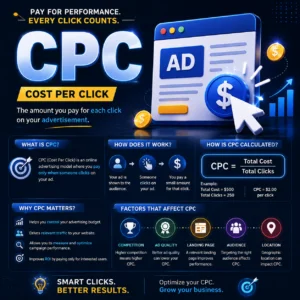
The Cost-Per-Click (CPC) system is based on a simple principle: the advertiser pays only when a user clicks on their ad, rather
than every time the ad is displayed. This makes CPC one of the most efficient payment models, as it focuses on actual interaction
with the ad rather than the number of times it appears.
The CPC operating mechanism involves a series of sequential steps, namely:
1. Creating the advertising campaign
The advertiser begins by creating an advertising campaign on a platform such as Google Ads or Meta Ads, then defines
the campaign objective, budget, and target audience, as well as the appropriate keywords or targeting criteria.
2. Entry of the ad into the ad auction
When a user performs a search or browses a platform, the ad enters an ad auction alongside other ads targeting the same
audience. The selection of the winning ad is not based solely on the bid amount; factors such as ad quality and its relevance
to the user's search or interests are also taken into account.
3. Ad display to the user
If the ad meets the platform's criteria, it will appear to the user in search results, on websites, or on social
media apps, depending on the advertising campaign settings.
4. User clicks on the ad
When a user finds the ad relevant and clicks on it, they are directed to the page specified by the advertiser,
such as a website, product page, or landing page.
5. Calculating Cost Per Click
Once the click occurs, the platform calculates the cost per click and deducts it from the advertising budget.
However, if the ad is displayed but not clicked, no cost is incurred for campaigns based on the CPC model.
Practical example
Let’s assume an online store launches an advertising campaign with a budget of $100 and a cost-per-click of
$0.50. If the ad receives 200 clicks, the entire budget will be exhausted, whereas the advertiser will incur no cost
for people who viewed the ad without clicking on it.
- ? How is CPC calculated
Calculating the Cost Per Click (CPC) is a fundamental step in evaluating advertising campaign performance,
as it enables advertisers to determine the amount paid for each user who clicks on an ad. This metric is used to
assess the efficiency of advertising spend and to make decisions that help optimize campaign performance and reduce costs.
CPC calculation formula
The cost per click is calculated using the following formula:
CPC = Total advertising campaign cost ÷ Total number of clicksIn other words, the total amount spent on the advertising campaign is divided by the number of clicks the ad received.
Practical example
Let's assume a company spent $300 on an advertising campaign, and the ad generated 600 clicks.
In this case, the cost per click is calculated as follows:
CPC = 300 ÷ 600 = $0.50This means that the company paid $0.50 for each click on the ad.
Another example
If the campaign budget is $150 and the ad generates 75 clicks, the cost per click will be:
CPC = 150 ÷ 75 = $2In other words, the advertiser paid $2 for every user who clicked on the ad.
- ? Why is CPC important in digital marketing
CPC (Cost Per Click) is one of the most important metrics used by marketers and business owners to
evaluate advertising campaign performance, as it helps determine the cost of attracting each visitor
to a website or landing page. By monitoring this metric, advertisers can measure the efficiency of their
ad spend and optimize their strategies to achieve the best results.
The following are the key reasons why CPC is a fundamental element in the success of advertising campaigns:
1. Measuring advertising spending efficiency
CPC helps determine whether the advertising budget is being used efficiently by showing
the cost of attracting each visitor to the site. If the cost per click is high without
yielding good results, this may indicate a need to optimize the campaign.
2. Improving budget management
By analyzing cost-per-click, the budget can be allocated more intelligently, focusing
on the best-performing ads or keywords while reducing spending on less effective campaigns.
3. Evaluating advertising campaign performance
CPC is used to compare the performance of different campaigns and ads, helping to identify the most
successful ads and optimize those yielding lower results.
4. Improving audience targeting
If the cost per click (CPC) is high, it may indicate that the target audience or keywords need adjustment.
Therefore, CPC helps refine targeting strategies to reach the most interested customers.
5. Improving Return on Investment (ROI)
When the cost per click is appropriate and leads to sales or conversions,
it becomes easy to increase the return on investment—the primary goal of most advertising campaigns.
6. Ease of measuring and improving results
CPC is characterized by ease of tracking and analysis, as the cost per click can be continuously
monitored and necessary campaign improvements made to enhance effectiveness and reduce costs.
- Factors Affecting Cost Per Click (CPC)
There is no fixed cost per click in advertising campaigns; the cost per click (CPC) varies from one campaign to another based on
several factors that directly influence the amount an advertiser pays for each click. Understanding these factors helps optimize
campaign performance and reduce costs while achieving better results.
The following are the key factors affecting CPC:
1. Keyword competition
Competition is one of the most significant factors influencing the cost per click (CPC).
When a large number of advertisers compete for the same keywords, bid values rise, leading to a higher CPC.
Conversely, keywords with less competition typically have a lower cost per click.
2. Ad Quality (Quality Score)
Platforms like Google Ads rely on Quality Score to evaluate ads, taking into account factors
such as ad relevance to the keyword, landing page quality, and expected click-through rate. The higher
the ad quality, the greater the likelihood of it appearing at a lower cost.
3. Click-Through Rate (CTR)
CTR is a key indicator that reflects how appealing an advertisement is to users. When an ad achieves a high click-through rate, the platform may deem it more relevant, which can help lower the cost per click and improve the ad's ranking.
4. Target Audience
Audience selection significantly impacts the cost per click (CPC). Targeting
a broad or highly competitive audience can drive up the CPC, whereas targeting a more
precise and interested audience helps improve campaign results and reduce costs.
5. Geographical Location
The cost per click varies from one country to another—and sometimes even from city to city.
Countries with high advertising competition often see higher costs per click compared to less competitive markets.
6. Type of field or industry
The cost per click (CPC) varies depending on the industry in which the company operates. For instance,
CPC is high in sectors such as insurance, legal services, finance, and real estate, whereas it is lower
in other sectors like education or e-commerce.
7. Landing Page Quality
Campaign evaluation is not limited to the advertisement alone; the landing page also plays a crucial role.
If the page is fast, user-friendly, and relevant to the ad's content, it can help improve the campaign's
quality and reduce the cost per click.
8. Ad display timing
The cost per click may vary depending on when the ad is displayed; prices rise during periods
of high user activity or increased competition among advertisers, and fall during less busy times.
9. The advertising platform used
The mechanism for calculating CPC varies across advertising platforms—such as Google Ads,
Meta Ads, and LinkedIn Ads—so the cost per click for the same campaign may differ when advertising on multiple platforms.
? What is a good average cost per click
There is no single, fixed figure that can be considered a good average for Cost Per Click (CPC), as this cost varies based on
several factors—such as the type of business, the advertising platform, geographic location, the level of competition, and the
target audience. Consequently, a specific CPC might be considered low in one industry while being high in another.
For example, the cost per click in sectors such as insurance, legal services,
and finance is often higher than in others due to intense competition among advertisers,
whereas it may be lower in areas like e-commerce or education.
Average Cost Per Click by Industry
The following are approximate average costs per click in certain sectors:
Industry Average Cost Per Click (CPC) E-commerce Low to Medium Education Medium Software as a Service (SaaS) Medium to High Real Estate High Finance & Financial Services High Insurance Very High Legal Services Very HighNote: These values vary by country and advertising platform, and may also change over time
depending on market conditions and the level of competition.
How do you know if the cost per click is good?
Evaluating CPC depends not only on how low it is, but also on the extent to which it contributes
to achieving campaign goals. A cost-per-click can be considered good when:
- It fits the advertising campaign budget.
- It generates high-quality, targeted visits.
- Lead to actual sales or conversions.
- It helps achieve a good return on investment (ROI).
- It is competitive compared to the market average in the same sector.
Does a lower cost-per-click mean the campaign is successful?
Not necessarily. A campaign might achieve a low cost-per-click (CPC) yet fail to generate any
sales or sign-ups, whereas another campaign with a higher CPC could yield a significant number of
customers and substantial revenue. Therefore, CPC must be analyzed alongside other performance indicators—such as
CTR (click-through rate), CPA (cost per acquisition), and ROAS (return on ad spend)—to accurately assess the campaign's success.
Therefore, CPC must be analyzed alongside other performance indicators—such as CTR (Click-Through Rate), CPA (Cost Per Acquisition),
and ROAS (Return on Ad Spend)—to accurately evaluate the campaign's success.
- Advantages of using the CPC model
1. Budget control
The CPC model allows advertisers to set a budget that suits their goals while paying only when the
ad is clicked, helping to manage spending efficiently.
2. Targeting an interested audience
This model relies on attracting users who interact with the advertisement, thereby increasing
the likelihood that the ad reaches people with a genuine interest in the product or service.
3. Accuracy of weight measurement
The number of clicks, click-through rate (CTR), and cost per click can be tracked, making it easier to evaluate campaign performance and continuously optimize it.
4. Improving Return on Investment
Analyzing CPC data helps optimize ads and reduce unnecessary costs, contributing to better results from the advertising budget.
5. Flexibility in campaign optimization
Keywords, targeting, and ad copy can be adjusted at any time to improve performance and reduce the cost per click.
- Drawbacks of using the CPC model
1. Rising costs in certain areas
The cost per click can be very high in highly competitive sectors such as real estate, insurance, and e-commerce.
2. Clicks do not guarantee sales.
Generating a large number of clicks does not necessarily translate into actual profits or conversions.
3. Likelihood of invalid clicks
Some campaigns may be subject to fraudulent or invalid clicks that consume a portion of the budget.
4. The need for continuous follow-up
The CPC model requires continuous monitoring and optimization of keywords and ads to achieve the best results.
5. Impact of competition
The more advertisers targeting the same keywords, the higher the cost per click and the more difficult it becomes to maintain a low cost.
What is CPC?
CPC stands for "Cost Per Click"—translated into Arabic as *taklufat al-naqra*—and is one of themost popular payment models used in digital advertising. Under this model, the advertiser pays a fee
for every user click on the ad, rather than paying based on the number of times the ad is displayed.
CPC is widely used across various advertising platforms, such as Google Ads and Meta Ads (Facebook and Instagram),
helping advertisers drive traffic to their websites or landing pages while maintaining control over their advertising
budgets and accurately measuring campaign performance. CPC is considered a key performance indicator in digital marketing,
as it reveals the cost of acquiring a single visitor to your website through a paid advertisement, thereby helping companies
and marketers evaluate campaign efficiency.advertising, and determining whether the budget is being spent effectively to achieve marketing goals. For example, if the cost per click is $1 and 100 users click on the ad, the advertiser pays a total of $100. Conversely, if the ad is displayed to thousands of people but no one clicks on it, no cost is incurred in campaigns basedon the CPC model. Because it relies on actual user interaction, CPC is a suitable choice for companies aiming to increase website traffic, generate leads, or encourage users to take specific actions—such as signing up for a service or purchasing a product. If you would like to learn more about the CPC model, you can consult this comprehensive guide.(https://www.wordstream.com/cost-per-click) و(https://support.google.com/google-ads/answer/2471184) و(https://blog.hubspot.com/marketing)و(https://www.semrush.com/blog/)
- What is CPA?
CPA (Cost Per Acquisition) is a digital marketing metric used to determine the cost of securing a
conversion—such as a product purchase, a new account registration, filling out a form, or downloading an app.
In other words, the advertiser is not concerned with the number of clicks, but rather with the final result achieved by the campaign.
Unlike CPC, which is based on payment for each ad click, CPA focuses on the cost of achieving a specific user action.
Consequently, it is widely used to measure the efficiency of advertising campaigns in achieving their actual objectives.
For Google's official explanation of Cost Per Acquisition (CPA), you can visit the Google Ads Help Center. https://support.google.com/google-ads/answer/6268632
-
If you want to succeed in selling products, you can also learn about affiliate marketing and how to profit from it.
- The difference between CPC and CPA
- How to reduce Cost Per Click (CPC)
The cost per click (CPC) can be reduced by improving the quality of advertising campaigns and adopting a
set of practices that help achieve better results at a lower cost; most notably:
1. Improving ad quality (Quality Score)
The more relevant the ad is to the keywords and audience needs, the higher the Quality Score becomes, which can
lead to a lower cost per click and an improved ad rank.
2. Choosing the right keywords
Use keywords relevant to your business, and balance high- and medium-competition keywords to achieve
the best results at the lowest cost.
3. Using negative keywords
4. Optimizing the Landing Page
Ensure that your landing page is fast, user-friendly, and offers content that aligns with the ad, as this contributes
to improving the user experience and increasing the campaign's quality.
5. Improving the Click-Through Rate (CTR)
Write compelling ad headlines and descriptions, and use a clear call to action (CTA);
the higher the click-through rate, the greater the chances of improving ad performance and reducing the cost per click.
6. Continuously reviewing and optimizing campaigns.
Monitor your campaign performance regularly, and adjust targeting, keywords, and ads based on the results
to achieve optimal performance at the lowest cost.
Tip: Do not aim solely to lower the cost per click; focus also on traffic quality and
conversion rates, as the cheapest click is not always the most profitable.
- Best practices for optimizing CPC campaigns
1. Set clear goals for the campaign.
Before launching the campaign, determine whether your goal is to increase visits, generate sales, or collect leads, so that you can accurately measure performance.2. Choose keywords carefully.
Use keywords related to your services or products, while continuously reviewing them to add effective keywords and exclude those that do not yield results.3. Create engaging ads.
Ensure you write clear headlines and descriptions that highlight the value of the product or service,
and include a call to action (CTA) that encourages the user to click.
4. Optimize the landing page.
Ensure that the landing page is fast, mobile-friendly, and offers a good user experience, as this contributes to
increasing the conversion rate.
5. Monitor campaign performance continuously.
Monitor performance indicators such as Cost Per Click (CPC), Click-Through Rate (CTR), and conversion rate,
then adjust your campaign based on the data to achieve the best results.
6. Test multiple versions of the ad.
Test different headlines, images, and copy to see which performs best, then adopt the most effective version.7. Target the right audience.
Use available targeting options—such as geographic location, interests, and age group—to ensure your ads
reach the audience most likely to engage.
8. Review the budget regularly.
Allocate the campaign budget to the ads or keywords that yield the best results, while reducing spending on underperforming elements.
- Conclusion
Ultimately, CPC (Cost Per Click) is one of the most important pricing models in digital advertising, helping advertisers manage their budgets and measure the cost of driving traffic to their websites. In this article, we have explored the concept of CPC, how it works, how it is calculated, and the factors influencing its cost, as well as its advantages, disadvantages, and best practices for optimizing campaign performance and reducing costs. However, CPC should not be the sole metric used to evaluate advertising campaign success; it is best analyzed alongside other indicators—such as CPA and ROAS—to gain a more comprehensive view and make more accurate marketing decisions. By understanding and correctly applying these metrics, you can enhance your campaign performance and achieve the best possible return on your advertising budget.